
When and how to take energy gels in cycling: the complete guide
You've had the gel in your jersey pocket since the start. Ninety minutes have passed and you still haven't touched it. Your legs are starting to complain and you open the gel when it's already too late.
This is the most common mistake in cycling nutrition. It's not about which gel to take — it's about when to take it. And the difference between getting it right or wrong can be the difference between finishing strong or crawling through the last 20 kilometres.
Why timing matters so much
Glycogen — the carbohydrate reserve stored in the muscles and liver — is the cyclist's primary fuel for medium-to-high intensity efforts. A 70 kg cyclist has approximately 400–500g of glycogen available, equivalent to around 2–2.5 hours of sustained effort before reserves drop to critical levels.
The problem is that when you feel the bonk — that moment when your legs stop responding and your head clouds over — you've already been in deficit for 20–30 minutes. Gels take between 10 and 20 minutes to be absorbed and reach the muscles. If you wait until you feel hunger or fatigue to take the first one, you're already too late.
The golden rule is simple: start before you need it and maintain the rhythm.
When to take the first gel
For rides over 90 minutes, the first gel should be taken between 45 and 60 minutes from the start, regardless of how you feel.
At that point the body still has reserves, the intestine is active and absorption is at its peak. It's the ideal moment to refuel before the tank starts to empty.
For rides under 90 minutes, if you've eaten well beforehand, you probably don't need gels. But if the intensity is high — intervals, long climbs, gran fondo — a gel at 45 minutes doesn't hurt.
How often to take the following ones
Once you've taken the first, the optimal pace for most cyclists is one gel every 30–40 minutes. This equates to around 60–75g of carbohydrates per hour, which is the range where performance stays stable without saturating the intestine.
At very high intensities — above threshold, col climbs — you can shorten to every 25–30 minutes. At low intensities, such as recovery rides or flat riding without effort, you can space them to every 45–50 minutes.
The trick is not to skip a dose even if you feel fine. Glycogen will deplete anyway — the feeling of being fine only warns you with a delay.
Before, during or after: each moment has its logic
Before setting off
A gel 15 minutes before an intense ride — a hillclimb TT, a fast group, a gran fondo — can help raise blood glucose and set off with a full tank. It's not essential if you've had a good breakfast 2–3 hours before, but on early morning rides or fasted sessions it can make a difference.
During the effort
This is the main use. One gel every 30–40 minutes from the first hour of pedalling. The key is to take it with a sip of water to aid absorption and avoid digestive discomfort.
On long climbs, take the gel just before the climb starts or in the early kilometres, not when you're already at your limit. The intestine under maximum effort absorbs much more poorly.
In the final kilometres
If you have 20–30 km left and you know there's a tough finish ahead, take a gel even if you don't feel you need it. Arriving at the final sprint or last climb with reserves is the difference between attacking or surviving.
How to take it correctly
With water, always. Concentrated gels need water to dissolve and be absorbed. A sip before and one after is enough. Without water, they can cause gastric discomfort, especially in heat.
Not with isotonic drink. If you're taking a carbohydrate drink, be careful about accumulating too many sugars at once. In that case, space the gels further apart or reduce the amount of drink.
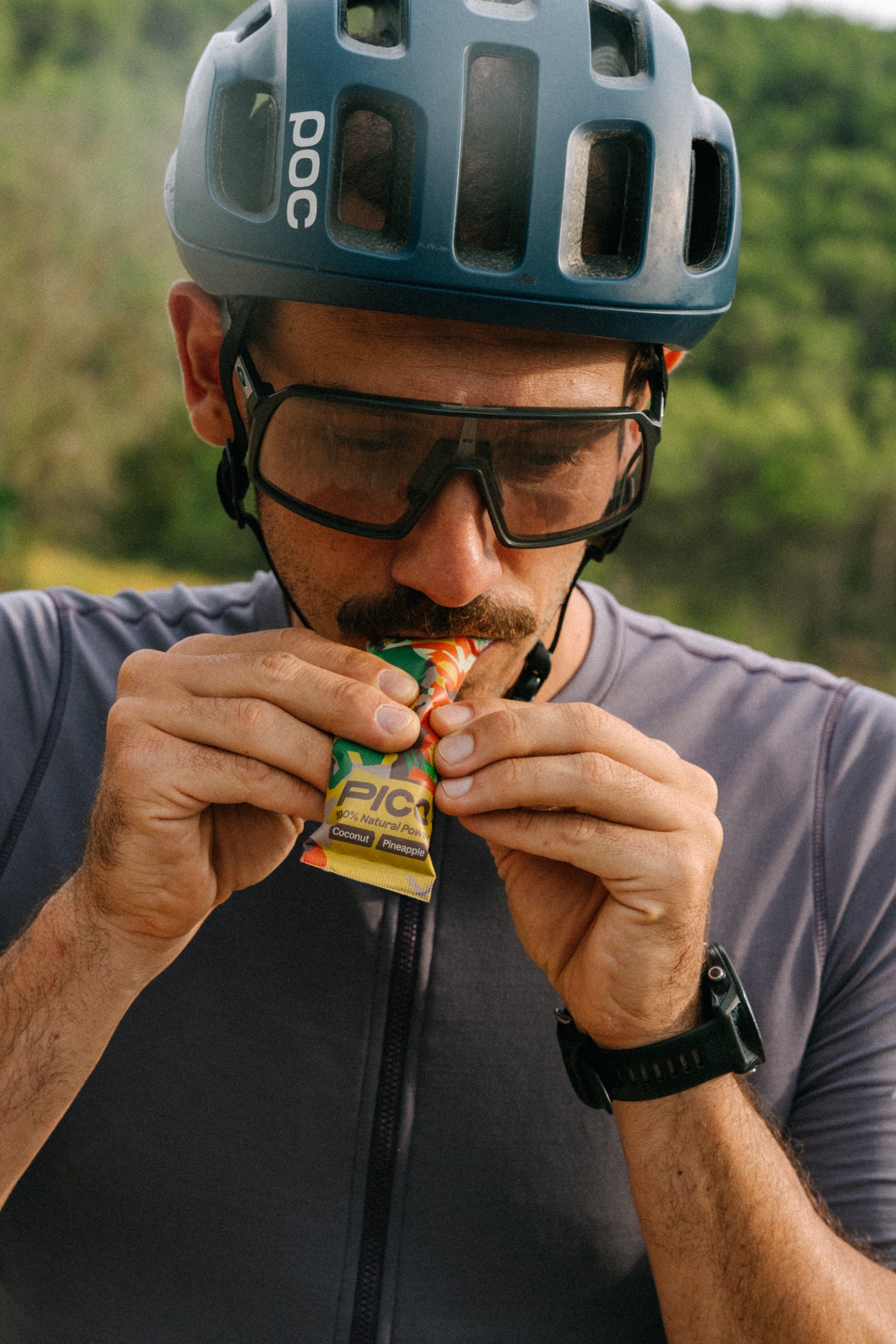
Open the gel before you need it. Opening a wrapper with one hand while riding in a group or on a descent is not the ideal moment. Get into the habit of pulling out and opening the gel in a calm moment, ready to take it when the time comes.
Keep the wrapper. Don't throw it on the road. In your jersey pocket or bidon pocket.
Common mistakes and how to avoid them
Waiting for the bonk. We've said it already, but it bears repeating: when you notice the bonk, the gel takes 15–20 minutes to take effect. You'll have lost several minutes of optimal performance. Set an alarm if necessary.
Taking two gels back to back to compensate. Doubling the dose doesn't speed up absorption — it only saturates the intestine. If you've fallen behind, take one now and the next in 20 minutes, not two at once.
Switching gels mid-race. Never try a new gel in a sportive or competition. Always train with the same gels you'll use on race day so your intestine knows them.
Ignoring the heat. In summer, concentrated gels are absorbed more slowly and the risk of digestive discomfort rises. Hydrate more and consider spacing doses slightly further apart.
A simple plan for your next ride
If your ride is 2–3 hours, here's the easiest plan to follow:
- Minute 0: set off well fed
- Minute 45–60: first gel
- Minute 90: second gel
- Minute 120: third gel (if still riding)
- Always with water, never more than 2 hours without eating
Simple, repeatable and effective. Nutrition in cycling doesn't have to be complicated — just consistent.
PICO FUEL gels for cyclists
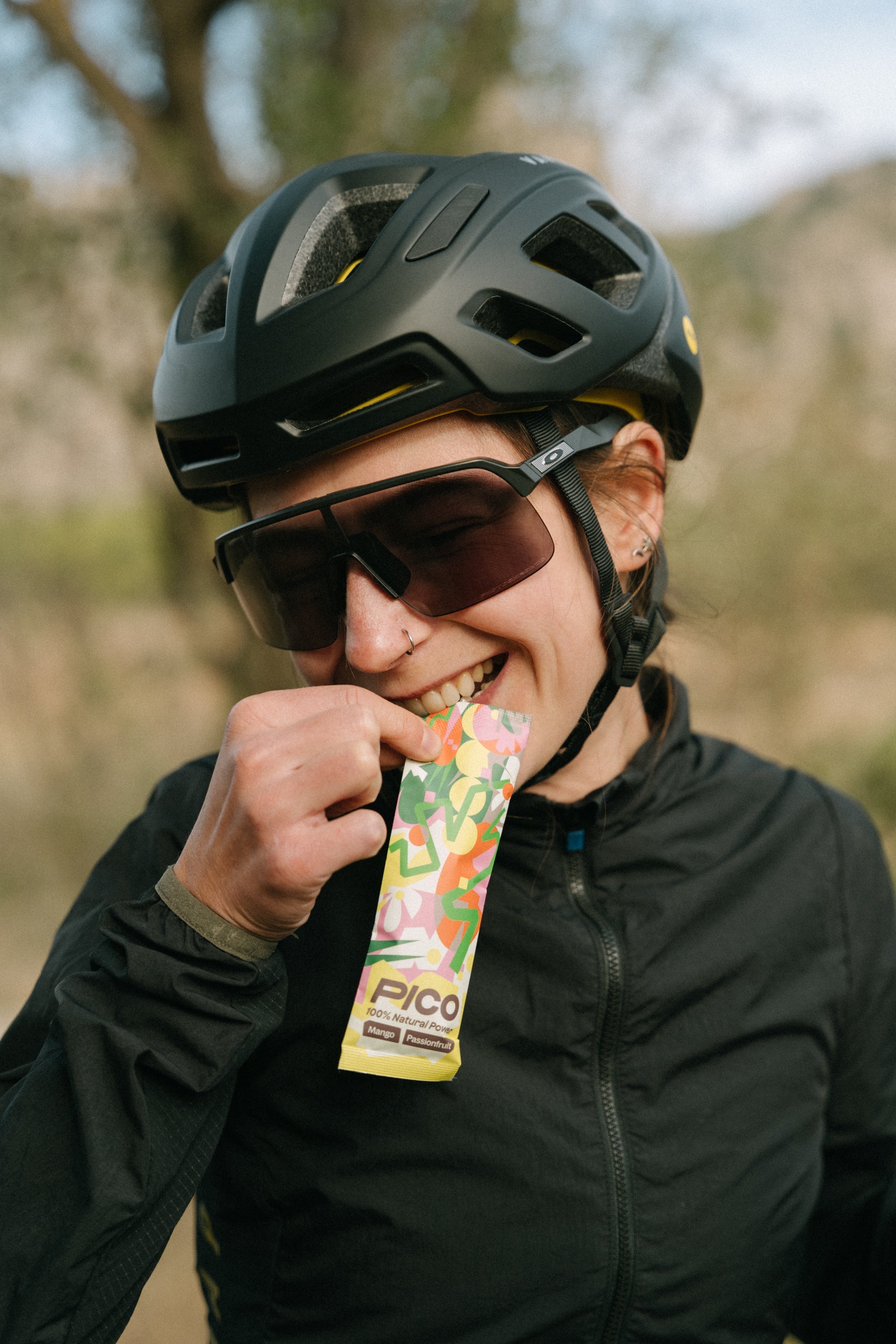
At PICO FUEL we've designed every gel with the cyclist in mind — the one opening it with one hand, at 35 km/h, from a jersey pocket. The 60g format is easy to open and take without losing rhythm. The natural ingredients — no preservatives or emulsifiers — mean the intestine accepts them well even during multi-hour efforts.
If your next ride is 2–3 hours, the pack of 12 has you more than covered. If you're planning a gran fondo or a sportive, the pack of 18 or 24 is your best option.