
Natural vs conventional energy gels: what difference does it make to your body
You've probably heard it before: eat natural, avoid processed food, read the labels. But when it comes to sports nutrition, most athletes do exactly the opposite — they grab a conventional gel, swallow it without thinking, and assume it's fine because it's designed for sport.
The reality is more complex. And the difference between a natural energy gel and a conventional one isn't just about ingredients — it's about what happens inside your body during effort.
What conventional gels are actually made of
Pick up any conventional energy gel and read the ingredients. You'll find maltodextrin as the first ingredient — a highly processed carbohydrate derived from corn, wheat or potato starch. Then fructose, artificial flavours, preservatives like potassium sorbate or sodium benzoate, acidity regulators, and sometimes caffeine.
Each of these ingredients serves a purpose: maltodextrin provides fast energy, preservatives extend shelf life, artificial flavours make the product palatable. From an industrial perspective, it works.
From a physiological perspective during effort, it's a different story.
What natural gels use instead
Natural gels replace processed ingredients with real ones. Instead of maltodextrin: rice syrup or agave syrup. Instead of artificial flavours: real fruit concentrate. Instead of preservatives: nothing — the product is made in small batches and consumed fresh.
The difference isn't cosmetic. Rice syrup has a lower glycaemic index than maltodextrin — it releases energy more gradually, avoiding the aggressive glucose spikes and subsequent crashes. Agave syrup is rich in fructose, which uses a different intestinal transporter than glucose, allowing the body to absorb more carbohydrates per hour without saturating the system.
Real fruit concentrate adds micronutrients and natural antioxidants that support recovery. Nothing artificial. Nothing your body has to decipher.
What the 2:1 ratio means and why it matters
The most important advance in sports nutrition of the last decade isn't a new molecule — it's understanding how to combine two that already exist.
Glucose and fructose are absorbed through different intestinal transporters. If you use only glucose (as most conventional gels do), you saturate the GLUT2 transporter at around 60g of carbohydrates per hour. But if you combine glucose and fructose in a 2:1 ratio, you use both transporters simultaneously and can absorb up to 90g per hour.
More energy available. Fewer digestive problems. Better performance on long efforts.
This is exactly the ratio used in PICO gels — not through processed formulas, but through the natural combination of rice syrup (glucose) and agave syrup (fructose).
The digestive difference — why it matters in practice
During intense exercise, blood flow to the digestive system drops by up to 80%. The gut is working with minimal resources at exactly the moment you're asking it to absorb carbohydrates.
Artificial additives, preservatives and highly processed ingredients require additional processing work from the gut. In normal conditions that's not a problem. During a race at 170bpm on the climb, it's the difference between finishing and stopping.
Natural gels, made with real ingredients the body recognises, reduce that digestive stress. Not because of magic — because physiology.
The performance difference — real or perceived?
There's a common argument: conventional gels work for professional athletes, so they must be fine. This argument has a flaw — professional athletes have spent years conditioning their gut to tolerate those products. Most amateur endurance athletes haven't.
Moreover, "works" and "optimises" are different things. A conventional gel sustains you. A natural gel sustains you without the inflammatory cost of artificial additives, without the glucose crash of pure maltodextrin, and without the digestive stress of preservatives during effort.
The difference is felt most clearly on long efforts — rides over 3 hours, trail runs over 2. That's when the accumulated effect of what you've eaten starts to matter.
Why PICO is different
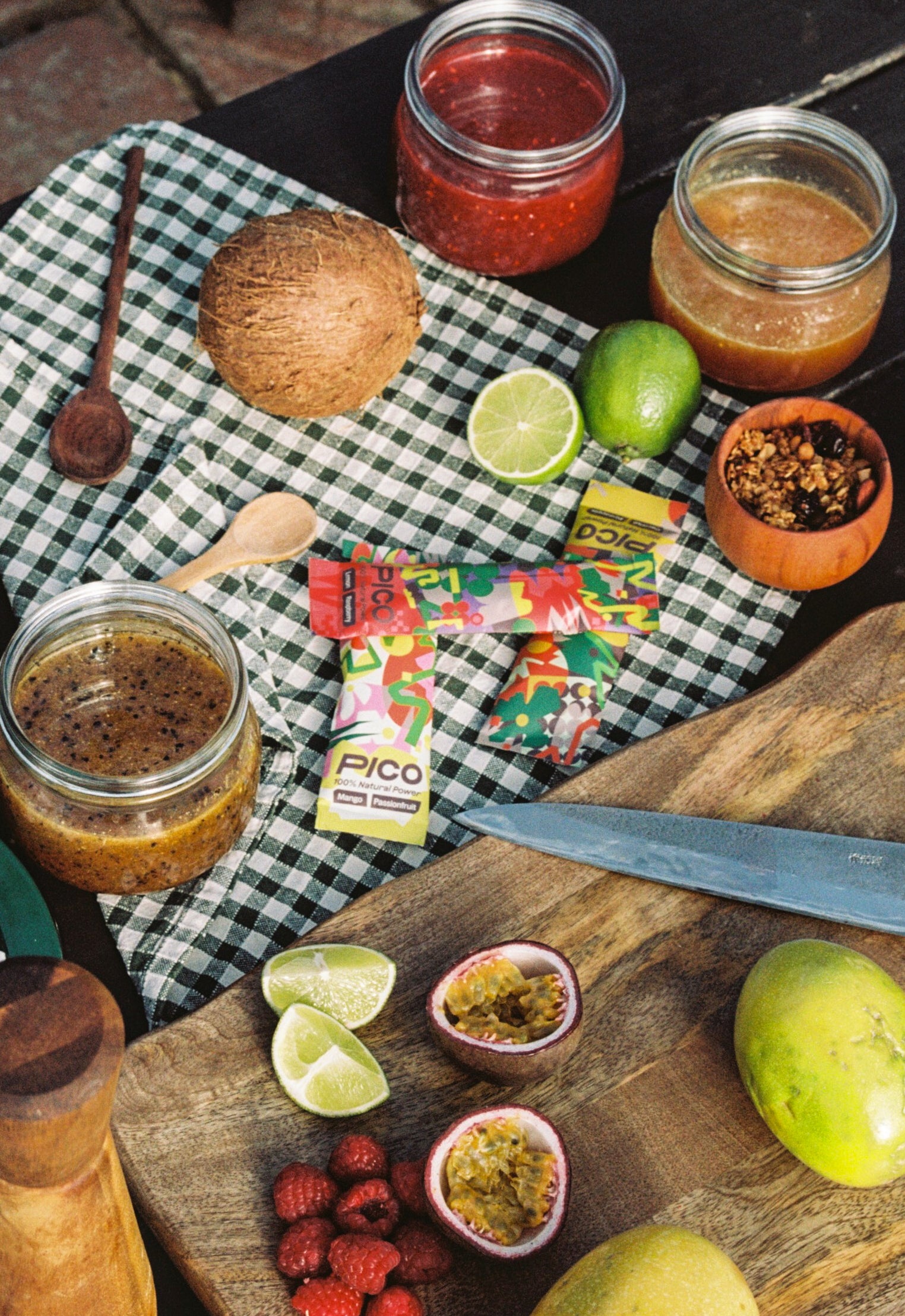
PICO gels contain just four ingredients: organic rice syrup, agave syrup, Himalayan salt and real fruit. No maltodextrin. No artificial flavours. No preservatives.
The result: 40–47g of carbohydrates per gel, a 2:1 glucose-to-fructose ratio, and a dense texture that absorbs gradually. Designed by a chef-cyclist who refused to accept that fuelling during sport meant tolerating something unpleasant.
Three flavours: Raspberry + Lime, Mango + Passionfruit, Pineapple + Coconut. Each one designed to still taste good at kilometre 50.